

StatementARBORES is the Latin word for Trees. Latin is still the basis for all botanical names, which provide a universal reference. In choosing a Latin name I want to emphasize the global significance of this species. Trees are important for the survival of the human kind. Unfortunately they are not very often treated with the respect they deserve. Trees have always played an important role in my life. Having grown up in a rural setting at the fringes of a major city, I was always surrounded by trees. We had fruit trees in our garden and there were two forests nearby, partly undisturbed, partly managed. Almost every Sunday afternoon was spent on extended walks. "Spazierengehen" was probably one of the most popular weekend pastimes of any German family, before TV finally took over their lives. I dedicate this exhibition to my parents, who not only have instilled in me a respect for nature and all living creatures, but also passed on to me a curiosity and awareness to see. Forest of My Childhood (images 17 - 21) revisits those two locations. After having been living in New Zealand for ten years, on my very first journey back to my place of birth in 2000, I reconnected with my special places and was even able to identify individual trees, with which I share memories. This series celebrates my ongoing connection with these places although being separated by half a world's distance. Urban Trees (images 1 - 14) is a story of survival. These trees have apparently assimilated to their surroundings. They even adapted similar colours. Although these trees look deprived, they are full of life. The images for this series were mostly taken during winter. While this reduces the appearance of the trees to their essential structure, in all their nakedness they also convey a very special beauty. Unfortunately, several of the Wellingtonian trees in this series have had their lives taken.
Wellington, June 2006 NotesForest of My Childhood (images 17 - 21) had been previously exhibited at GaleriaZero in Barcelona in 2001 with identical layout of the display (below). 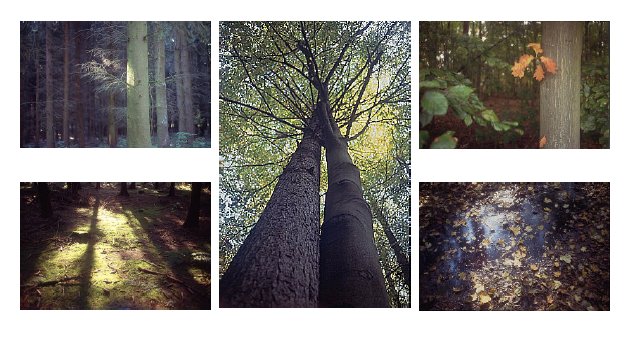 The 2006 exhibition at Photospace Gallery closed with a 22nd print featuring an image made by the mother of the artist. This print was not for sale and served as a closing reference to the dedication to the parents of the artist in the statement introducing the exhibition. Technical Note
Prints 1 thru 16 are Archival Ink Jet Prints produced with an EPSON 2100 printer
and EPSON UltraChrome Inks on EPSON Archival Matte Paper in June 2006. |



All Rights Reserved.
Reproduction of images or text only with permission in writing.